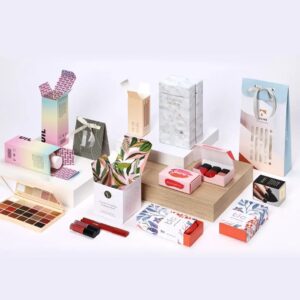
Cardboard vs rigid boxes is one of those decisions cosmetic brands wrestle with more than they expect to. Sounds straightforward on paper. In reality, it’s a choice that touches your price point, your customer experience, your shipping costs, and honestly, how seriously people take your brand the moment they pick your product up.
Both formats work. But they don’t work for the same brands, the same products, or the same customers.
Here’s an honest breakdown of both.
What Cardboard Cosmetic Boxes Actually Are
Custom Cardboard boxes, folding cartons specifically, are what most retail cosmetic packaging is built from. You’ve seen them your whole life. Foundation boxes, serum cartons, lipstick packaging, skincare sets. That clean, lightweight format that assembles flat and prints beautifully? That’s folding carton paperboard, typically sitting between 300 and 600 GSM.
They’re practical, cost-effective, and genuinely good at what they do. Don’t let “cardboard” make you picture something flimsy. At the right GSM, a folding carton is sturdy enough for real shipping conditions and clean enough to carry detailed print with accurate color reproduction.
For brands launching a new line, scaling at volume, or working with tight margins, folding cartons are often exactly the right call.
What Rigid Cosmetic Boxes Actually Are
Rigid boxes are a completely different object. Thick chipboard — usually 800 to 1500 GSM — wrapped in printed or textured paper, built to hold its shape permanently. No folding. No flat packing. They arrive assembled, and they stay that way.
Pick one up, and you feel it immediately. That weight. That solidity. The sense that whoever made this actually thought about the details.
Unlike folding cartons, rigid cosmetic packaging doesn’t collapse or bend under pressure. It holds its corners.Holding its corners and structure firmly, it sits on a shelf or dresser looking exactly as it did the day it was made.
That durability is a big part of why customers keep them. They don’t throw rigid boxes away — they store things in them, display them, reuse them. Your brand lives in someone’s space long
after the product is finished. Our custom rigid boxes are built precisely around that staying power.
Usage Purpose Explained
Rigid Boxes – Ideal for Luxury Packaging and Presentation
Rigid boxes are designed to enhance how your product is perceived. Their sturdy structure, premium materials, and elegant finishes make them perfect for showcasing high-end items.
They are commonly used for products like cosmetics, perfumes, jewelry, and gift sets, where presentation plays a key role in influencing customer decisions. These boxes create a memorable unboxing experience and help position your brand as premium and high-quality.
Cardboard Boxes – Ideal for Shipping and General Packaging
Cardboard boxes are built for practicality and efficiency. Their lightweight, foldable structure makes them easy to store, assemble, and transport, which is why they are widely used for shipping and everyday retail packaging.
They provide sufficient protection during transit while keeping costs low, making them a smart choice for bulk packaging, e-commerce deliveries, and products that require functional
rather than luxury packaging.

Features: Rigid Boxes vs Cardboard Boxes
Feature | Rigid Boxes | Cardboard Boxes |
Material Quality | Made from high-density chipboard for a solid feel | Made from lightweight corrugated or paperboard material |
Durability | Highly durable and long-lasting | Moderately durable, designed for short-term use |
Thickness | Thick (1.5–3mm), gives a sturdy structure | Thin to medium thickness depending on type |
Structure | Non-collapsible, retains its shape | Foldable and flexible |
Visual Appeal | Premium, luxury, high-end look | Simple, standard appearance |
Printing Quality | Supports high-quality printing and finishes | Basic to moderate printing quality |
Finishing Options | Matte, gloss, embossing, foil stamping, lamination | Limited finishing options |
Branding Value | Strong brand positioning and perceived value | Basic branding support |
Weight | Heavier due to dense material | Lightweight and easy to handle |
Storage | Takes more space (pre-assembled) | Easy to store (flat-packed) |
Cost Efficiency | Higher cost due to premium build | Cost-effective and budget-friendly |
Usage Purpose | Ideal for luxury packaging and presentation | Ideal for shipping and general packaging |
Reusability | Reusable, often kept by customers | Usually disposable after use |
Customer Experience | Enhances unboxing and brand experience | Focused on functionality |
Business Value | Builds brand perception & customer loyalty | Smart, scalable choice for bulk operations |
Best Use Strategy | Expensive but delivers high perceived value | Cheap, scalable, and eco-friendly solution |
Ideal Application | Best for luxury products, gifting & premium lines | Best for bulk selling, e-commerce & shipping |

Cardboard Boxes — Where They Win
- Volume and cost efficiency. If you’re shipping thousands of units a month, folding cartons keep your per-unit packaging cost manageable without sacrificing quality. That matters at scale.
- Retail shelf presence. Well-printed folding cartons with the right finish — matte lamination, gloss, spot UV, foil stamping — look genuinely premium on shelf. The finish does the heavy lifting.
- A well-executed cardboard cosmetic box can compete directly with much more expensive packaging formats if the design and print quality are there.
- Tuck-end, reverse tuck, auto-lock base, window cut-out — folding cartons come in more structural variations than most brands realize. There’s a lot of room to create something distinct without stepping up to rigid.
- Eco-friendly options. Kraft board, recycled paperboard, FSC-certified stock, soy-based inks — if sustainability is a core part of your brand, folding cartons give you more eco material options than rigid. Our custom kraft boxes are worth exploring if clean beauty positioning matters to your brand.
Rigid Boxes — Where They Win
- Premium perception. Nothing signals luxury faster than a rigid box. The weight alone communicates quality before the customer processes anything consciously. In a market where perceived value directly affects what customers will pay, that signal matters enormously.
- The unboxing moment. Magnetic closure rigid boxes, drawer-style openings, lid-and base formats — these create experiences that folding cartons structurally can’t. That moment is what gets filmed, shared, and talked about.
- In beauty, where social media is a genuine sales channel, packaging that creates a moment is packaging that earns reach you didn’t pay for directly.
- Customer loyalty. Customers who receive a product in beautiful luxury cosmetic packaging feel differently about the brand. They trusted you more. They come back more
- They’re more likely to recommend you. Packaging that makes someone feel good about their purchase is packaging that builds a customer base — not just a transaction. Long-term brand visibility. People keep rigid boxes. On dressers, in wardrobes, on shelves. Months after the product is gone, your brand is still in their space. That passive visibility is something no ad budget can replicate.
So Which One Should You Choose?
Depends on three things.
- Your price point. If your product retails under $20, rigid packaging may push your cost structure into difficult territory. Folding cartons with premium finishes get you most of the visual impact at a fraction of the cost. If your product sits at $50, $80, $100+ — rigid packaging is consistent with what customers at that price point expect.
- Your product type. Day-to-day skincare, foundations, serums — folding cartons work perfectly. Gift sets, hero products, limited editions, fragrance, premium skincare — rigid boxes earn their cost back in perceived value and customer retention.
- Your customer. Someone buying a weekly moisturizer thinks differently about packaging than someone buying a birthday gift or treating themselves to something special. Match the packaging to the purchase mindset.
Some brands use both — folding cartons for their everyday line, rigid boxes for their hero products or gift sets. That’s not a compromise. That’s smart resource allocation.
At Custom Box Master, our custom cosmetic boxes cover both formats, and a lot of brands order across both to keep their range coherent.
Why Choose Custom Box Master
Plenty of suppliers will tell you they handle both formats. Fewer will actually help you figure out which one makes sense for your product, your brand, and your actual budget.
Here’s what working with Custom Box Master actually looks like.
- Orders from 100 units. Rigid or cardboard, you’re not being pushed into a massive run before you’ve tested anything. A hundred units is enough to launch, test the market, take to stockists. That’s where we start.
- Honest material guidance. Before we recommend anything, we ask about your product, your price point, your shipping routes. The goal is the format that actually fits, not whatever’s easiest for us to produce.
- Free design support. Got artwork? We work with it. Rough idea and a logo? We build from that. Nothing except a sense of your brand? We start there. No extra invoice at the end.
- Free shipping across the USA. On every order. Nothing added at checkout. Zero.
- Consistent quality across every run. Same finish, same color, same construction quality from your first order to your fiftieth. That consistency is rarer than it should be — and it’s what keeps customers trusting your brand every time a new batch of stock arrives.
- Full finish range on both formats. Matte lamination, gloss, soft touch, foil stamping, embossing, debossing, spot UV, available across cardboard and rigid.
If you’re building out a full beauty range, our custom cardboard boxes and custom cosmetic boxes are designed by Custom Box Master to keep everything consistent.
Frequently Asked Questions
Is rigid packaging worth the extra cost for cosmetics? For premium products, gift sets, and hero SKUs — yes, consistently. The uplift in perceived value, customer retention, and unboxing experience tends to justify the cost at mid-to-high price points. For everyday retail lines, well-finished folding cartons usually make more commercial sense.
Can small beauty brands afford rigid boxes? More easily than most expect. With minimums starting at 100 units, rigid cosmetic packaging is accessible without committing to thousands of units upfront.
Which format photographs better for e-commerce? Both photograph well with the right finish. Rigid boxes with magnetic closures and foil stamping tend to perform better in unboxing content specifically. Matte folding cartons with foil details perform strongly in flat lay and product photography.
Can I use both formats for the same brand? Absolutely — and a lot of successful cosmetic brands do. Folding cartons for the everyday range, rigid boxes for premium or gift lines. Keeps cost where it should be while still delivering a luxury experience where it counts.
How long does production take? Standard production runs 8 to 12 business days on both formats. Rush options are available when timing is tight.
Ready to Elevate Your Cosmetic Packaging?
Stop guessing—start packaging with purpose. Whether you need cost-efficient cardboard boxes or luxury rigid packaging, we’ll help you choose what actually works for your brand.
Get your custom quote in minutes and bring your packaging vision to life today.